The kitchen floor, the bedroom, a cleared section of the sitting room: adequate space for the six movements that form the foundation of any beginner bodyweight programme. Equipment is not the limiting factor. Repetition is.
Why Bodyweight Before Weights
Resistance training with external load — dumbbells, barbells, cables — produces excellent results, but the barrier to beginning is higher than most accounts suggest. Learning to move well under load requires time, instruction, and access to equipment. Bodyweight training requires none of these. It can be begun today, in any room, with no prior instruction beyond what this article provides.
More importantly, the movement patterns learned through bodyweight training — squat, hinge, push, pull, carry, brace — are identical to those used with external load. A person who can perform twenty-five clean bodyweight squats has already learned the motor pattern that a barbell back squat requires. The transition to external load, when it comes, is a matter of load management rather than pattern learning.
For the beginner working at home, the case for beginning with bodyweight is practical as much as physiological: the only space required is approximately two metres by one metre. No ceiling height restrictions, no noise concerns, no timing requirements tied to a gym schedule.
"The kitchen floor is sufficient. Consistency across six weeks produces more adaptation than any equipment purchase."
The Six Foundational Movements
The programme below uses six movements covering the primary movement patterns of the lower body, upper body push, upper body pull, and trunk. These are not exercises chosen for novelty — they are the movements supported by the longest evidence base for beginner adaptation and the lowest injury risk when performed at appropriate volume.
Stand with feet shoulder-width apart. Lower by pushing the hips back and bending the knees until the thighs are parallel to the floor or as low as comfortable. Keep the chest upright throughout. Drive through the heels to return to standing.
Stand with feet hip-width apart. Push the hips backward while maintaining a neutral spine and a slight bend in the knees. Lower until you feel a stretch in the hamstrings — typically shin-level. Return to standing by driving the hips forward.
Place hands on a surface elevated between knee and hip height — a kitchen counter, sturdy chair, or step. Maintain a straight line from heels to shoulders. Lower the chest toward the surface, then press away. Progress to floor push-ups when twelve repetitions feel manageable.
Lie on your back with knees bent and feet flat on the floor, hip-width apart. Drive the hips upward by squeezing the glutes, forming a straight line from shoulders to knees at the top. Hold for two seconds at peak contraction, then lower slowly.
Lie on your back with arms pointing toward the ceiling and knees bent at ninety degrees. Lower one arm overhead while extending the opposite leg, keeping the lower back pressed against the floor throughout. Return and alternate sides. This is one of the safest and most effective beginner core exercises available.
Begin on forearms and knees — not toes — until a thirty-second hold is comfortable. Maintain a straight line from the crown of the head to the knees. Do not allow the hips to rise or sag. Breathe steadily. Progress to toes-down when thirty seconds feels unchallenging.
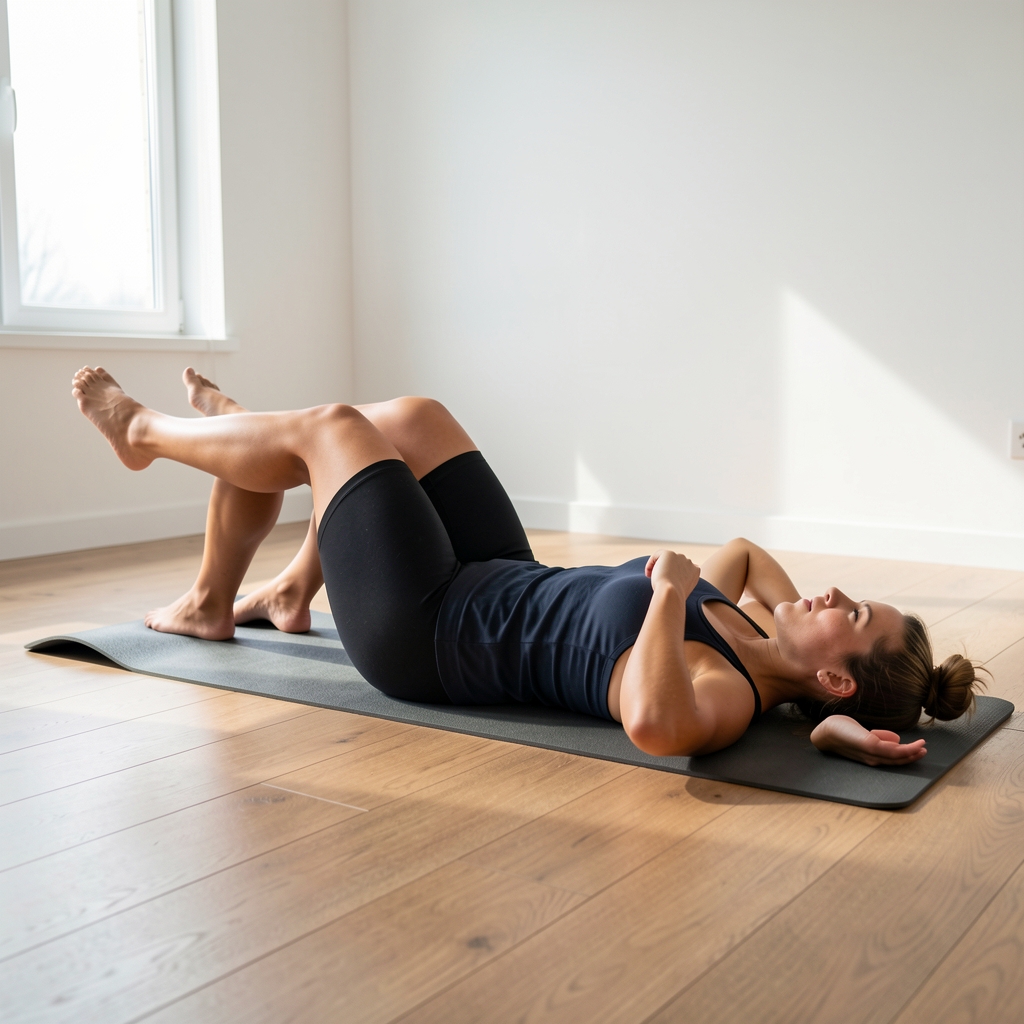
The glute bridge: the most frequently under-recommended beginner exercise for lower body posterior chain development.
Session Structure and Frequency
A complete session using all six movements above takes between twenty and twenty-five minutes, including two-minute rest intervals between sets. This is the target session length for weeks one and two.
Frequency: three sessions per week, with at least one full rest day between each session. A common schedule is Monday, Wednesday, Friday. This frequency is supported by research as the minimum effective dose for beginner strength adaptation and the schedule that produces the most consistent long-term adherence.
- Weeks 1–2: Three sessions weekly, all six movements, sets and reps as listed above
- Weeks 3–4: Increase squat and hip hinge to 3 × 12 — all other movements unchanged
- Weeks 5–6: Introduce floor push-up if incline push-up is comfortable; extend plank to 30 seconds
- Rest intervals: 90 seconds to 2 minutes between all sets — this is not optional
- Session completion is the metric — not pace, not burn, not sweat level
What Discomfort Is Normal
Muscle soreness in the twenty-four to seventy-two hours following the first two sessions is expected and is not a sign of injury. This delayed onset muscle soreness — commonly abbreviated DOMS — is the result of microscopic damage to muscle fibre that the body repairs with additional tissue. It is the mechanism of adaptation.
Sharp pain during an exercise, joint pain that worsens with repetition, or pain that persists beyond seventy-two hours are not normal and warrant stopping the relevant movement and seeking advice. These presentations are uncommon when exercises are performed with the described technique and at the recommended volume.
The single most common technique error in beginners is excessive speed. Every repetition in this programme should be performed under control — approximately two seconds down, one second pause, two seconds up. This tempo increases muscle activation and reduces injury risk simultaneously.
After Six Weeks
Six weeks of three-session-per-week bodyweight training, completed consistently, produces measurable improvement in functional strength, posture, and daily energy for the majority of beginners who complete it. The programme is a foundation, not a destination.
The natural next step is progressive overload — either through increased repetitions, slower tempo, reduced rest intervals, or the introduction of a small external load. The third article in this series addresses the construction of a sustainable weekly training plan that incorporates both walking and bodyweight sessions, with guidance on how to structure progression over a twelve-week period.