Walking is the most frequently abandoned form of exercise among first-time movers — not because it is too difficult, but because it is treated as too simple to require a plan. This is a four-week framework that treats it otherwise.
The Case for Starting with Walking
There is a persistent assumption in fitness writing that walking does not count as real exercise — that it is merely a prelude to something more demanding. The evidence does not support this view. For individuals beginning from a sedentary baseline, a structured walking programme produces measurable improvements in cardiovascular endurance, joint mobility, and energy across a day. The research base here is substantial and consistent.
What walking offers that more intensive activities do not is a very low barrier to recovery. A twenty-minute walk at moderate pace does not require a rest day. It can be performed in ordinary clothes, on any surface, in almost any weather. The habit formation potential is consequently much higher than that of activities which demand equipment, a journey, and a recovery period.
London, 2026 — this article was assembled from correspondence with four first-time exercisers who used the programme below over a consecutive twelve-week period. Their accounts informed the weekly structure and the pacing notes.
"The most reliable indicator of whether a beginner will sustain a walking routine is not fitness level — it is whether the route feels genuinely convenient."
Before the First Session
Two practical decisions precede the first walk. The first is footwear. Comfortable, supportive shoes with adequate cushioning are the only equipment requirement. Running shoes are suitable; dedicated walking shoes are equally effective. Flat-soled shoes, sandals, and boots with hard soles are not recommended for daily use on hard surfaces.
The second decision is route selection. The route should begin and end at the same point — typically home — and should be navigable without a map after two or three repetitions. Familiarity reduces the cognitive overhead of the activity, which matters particularly in the early weeks when motivation reserves are shallow.
An exercise timer is useful but not essential. A standard smartphone with the display visible is sufficient for tracking duration. Step-count applications are available if preferred, though duration-based targets are generally more reliable for beginners.
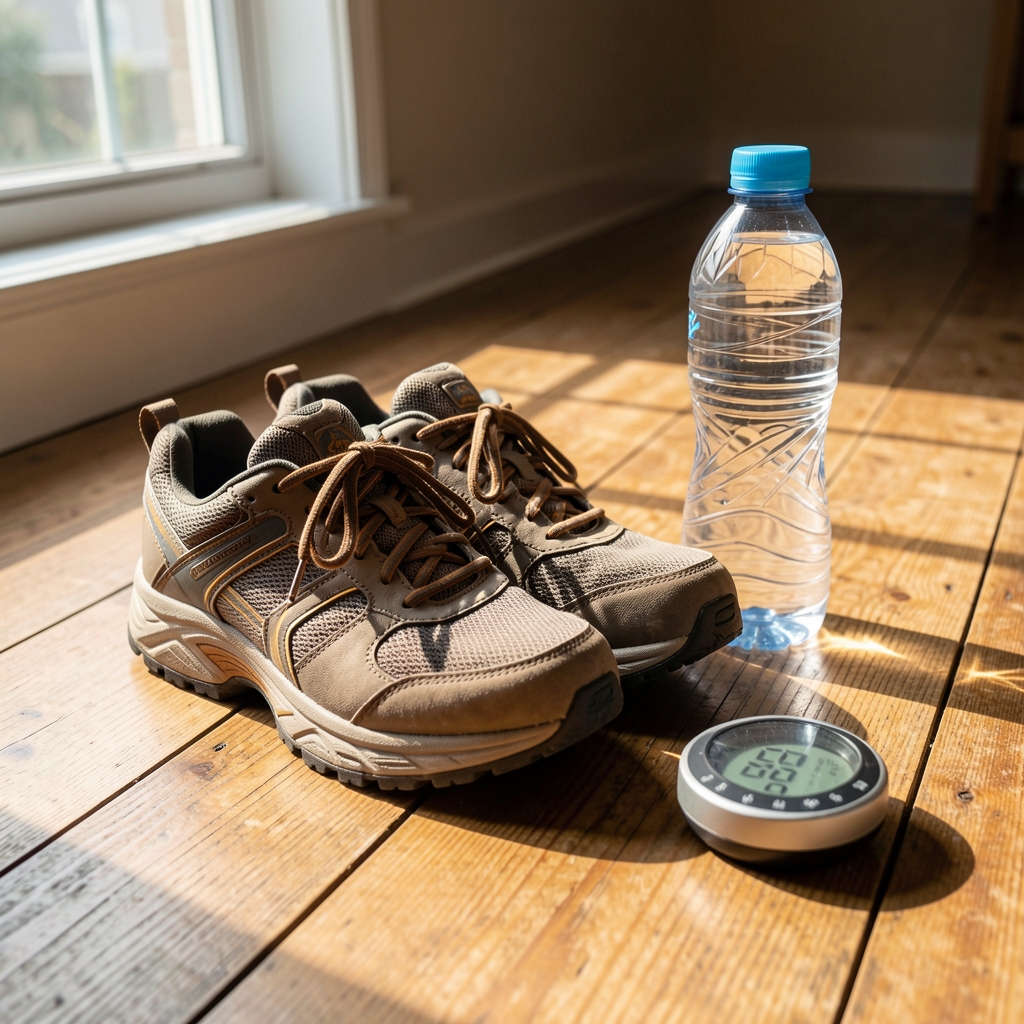
Equipment notes: supportive footwear, a water bottle, a timer. London, January 2026.
The Four-Week Programme
The structure below is designed for someone who currently takes fewer than 3,000 steps on a typical day. Each week targets a modest increase in total walking time, with two rest days in each seven-day period. The rest days are not optional — they are the sessions during which the body consolidates the adaptation to increased load.
Five sessions of fifteen minutes each. Pace: conversational — you should be able to speak a full sentence without pausing for breath. Total walking time: 75 minutes. Rest days: Wednesday and Sunday.
Five sessions of twenty minutes each. Same conversational pace. Introduce one inclined surface if your route permits — a gentle gradient of any kind. Total walking time: 100 minutes. Rest days: Wednesday and Sunday.
Five sessions of twenty-five minutes. Within each session, include five minutes at a brisk pace — fast enough to feel your breathing become noticeably deeper. The brisk interval can be at any point in the walk. Total walking time: 125 minutes.
Four sessions of thirty minutes, plus one longer session of forty-five minutes on the weekend. The longer session introduces a new route. Total walking time: 165 minutes. This week marks the threshold at which the walking habit becomes reliably self-sustaining.
Warm-Up and Cool-Down
A warm-up for walking is brief and requires no additional time outside the session itself. Begin each walk at a slow pace for the first three minutes, allowing the lower body joints — ankle, knee, hip — to move through their range without sudden loading. This is the warm-up. No separate stretching routine is needed before a walking session.
The cool-down is slightly more structured. At the end of each session, slow to a stroll for two minutes, then stop. Perform a standing calf stretch — one foot forward, one back, rear heel flat on the ground — held for twenty seconds each side. Follow with a standing hip flexor stretch, holding a surface if balance is uncertain. This sequence addresses the two muscle groups most commonly tight after walking on hard urban surfaces.
What to Track and What to Ignore
For the first four weeks, the only metric worth tracking is session completion. Write it down — a tick in a notebook is sufficient. The act of recording completion builds the sense of accumulating progress that sustains the habit through weeks two and three, which are statistically the most likely abandonment points.
Step count is a secondary metric and can be noted but should not become the primary focus. Step targets — particularly the common figure of 10,000 steps — were not derived from exercise research and have no special significance. Duration and consistency are the variables that correlate with sustained habit formation.
- Track session completion, not performance metrics
- Note how the walk felt — energy level before and after
- Record the route used, to support variety in later weeks
- Flag rest days in the same log — they are sessions
- Review the log at the end of each week, not each day
After Week Four
The programme above is a foundation, not an endpoint. At the close of week four, most participants find that thirty-minute walks have become effortless at conversational pace. This is the correct moment to introduce either longer duration, light resistance training alongside the walking routine, or a more structured interval walk format.
The subsequent step — a bodyweight exercise sequence performed on non-walking days — is covered in the second article in this series. The principle is the same: modest load, consistent frequency, recorded completion.
Walking, documented carefully and repeated without interruption for four weeks, changes the baseline. That change is the point.